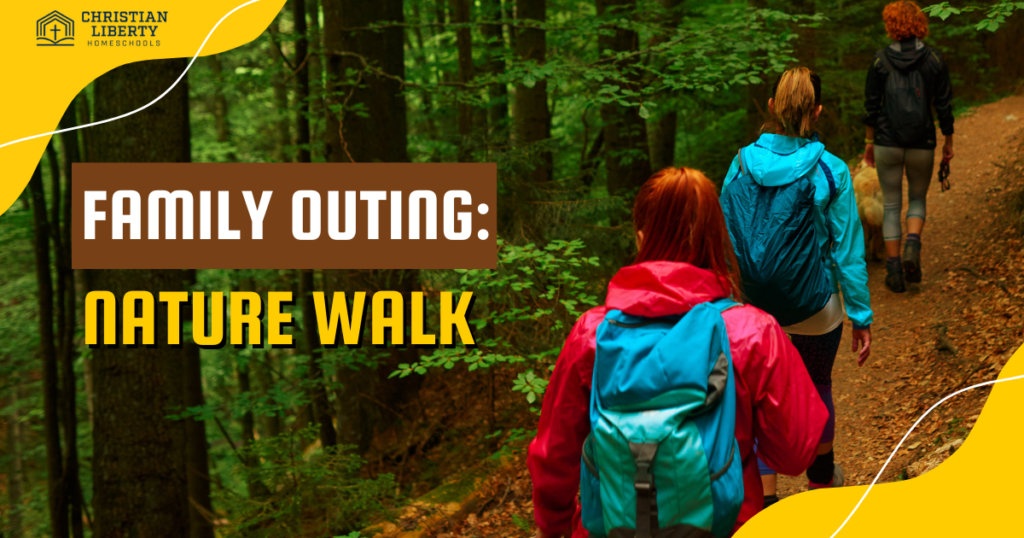
Simplicity is Key to a Family Outing Nature Walk
Sometimes the simplest activities, such as a family outing nature walk, are the best for bringing a Christian family together. When the activity doesn’t require too much concentration, family members have the freedom to communicate with one another. Think of ways that create excellent opportunities where your family can enjoy one another’s company. Include just enough structure to help everyone stay interested, but try to allow for plenty of conversation.
Prepare Prior to Departure
One good family activity is a nature walk. Keep in mind that even an ordinary family outing nature walk is not the same. Children might be running ahead or lagging behind. In a nature walk, everyone should stay close, on order to study and enjoy things together. While you might simply set out on a walk with no planning, it is best to give a little thought ahead of time to a nature walk. Plan a route that is likely to provide a lot of interesting things to look at. Bring along things that could be useful: like binoculars, a glass jar, or a bird or plant book.
An Opportunity for Godly Learning
A nature walk provides the opportunity for a lot of godly learning. Try concentrating on a particular type of wildlife in order to help your children learn how things are related to one another. One day, for example, you could simply watch for birds. Bring along binoculars and a bird book, and see how many different kinds of birds you can identify. Encourage discussion, whether it is about what you are viewing or not. If your children show particular interest, consider purchasing a building a bird feeder and bath. In this way, you can continue learning about birds every day.
A Family Outing Nature Walk Also Provides Numerous Opportunities for Learning
You can concentrate on many other things as well. Look for spiders and insects and collect them in a jar. Watch for small animals like squirrels, chipmunks, or groundhogs. Identify different plants and trees with the help of a field book. Take a walk by a stream or in the woods and see what kinds of things live and grow in these special places.
A Moment to Strengthen Family Bonds
A family outing nature walk is not just good family fun. It brings family members closer. It is also an excellent opportunity for you to teach your children about God’s miraculous and beautiful creation. Take your family on a nature walk at the soonest opportunity. Try it this weekend.
This article was written by our founder, Dr. Paul D. Lindstrom, for his radio program for homeschoolers: “There’s No Place Like Home.”
Christian Liberty Homeschools provides a unique alternative to traditional government education by emphasizing the true essence of education: freedom. You can enjoy family outings without the stress of missing school. With CLH, as a parent, you have complete authority over your child’s academic, cultural, historical, media, and spiritual experiences!
We are here to assist you at: www.homeschools.org
Additional Resources & Ideas
Here’s a more detailed breakdown of resources and ideas for a family nature walk:
Before You Go:
Plan Your Route:
Choose a park, trail, or natural area near Mt. Prospect that’s suitable for your family’s age and abilities.
Check the Weather:
Dress appropriately for the weather and pack layers.
Pack Essentials:
- Water and snacks
- First-aid kit
- Sunscreen and hats
- Small backpacks for kids to carry their own items
- Binoculars (homemade or store-bought)
- Notebooks and pencils for journaling
- Cameras (digital or disposable)
- Small buckets or bags for collecting nature items (optional)
Choose a Theme or Activity:
- Nature Scavenger Hunt: Create a list of things to find (e.g., a feather, a smooth rock, a leaf with a specific shape).
- Nature Journaling: Encourage kids to draw, write, or paint what they see and learn.
- Focus on a Specific Topic: Choose a theme like trees, birds, insects, or animal tracks.
- Sensory Walk: Pay attention to the sights, sounds, smells, and textures of nature.
- “I Spy” Nature Edition: Play “I Spy” with nature items.
- Nature Obstacle Course: Create a simple obstacle course using natural elements.
- Tree Rubbings: Use crayons and paper to make rubbings of tree bark textures.
- Animal Track Identification: Look for animal tracks and learn about the local wildlife.
Consider Age Appropriateness:
Tailor the activities and challenges to the ages and interests of the children.
During Your Walk:
- Stay Focused and Engaged: Encourage kids to observe and ask questions.
- Use Your Senses: Engage all five senses to appreciate the natural world.
- Take Breaks: Stop to rest, have a snack, or enjoy the scenery.
- Document Your Walk: Take photos or write in your nature journal.
- Learn About Local Flora and Fauna: Use field guides, apps (like iNaturalist or Leafsnap), or online resources to identify plants and animals.
- Be Respectful of Nature: Leave no trace and follow park rules.
After Your Walk:
- Share Your Experiences: Discuss what you learned and saw on the walk.
- Create Nature Art: Use the collected items to make collages, nature boxes, or other crafts.
- Continue the Learning: Explore nature-related books, websites, or museums.